
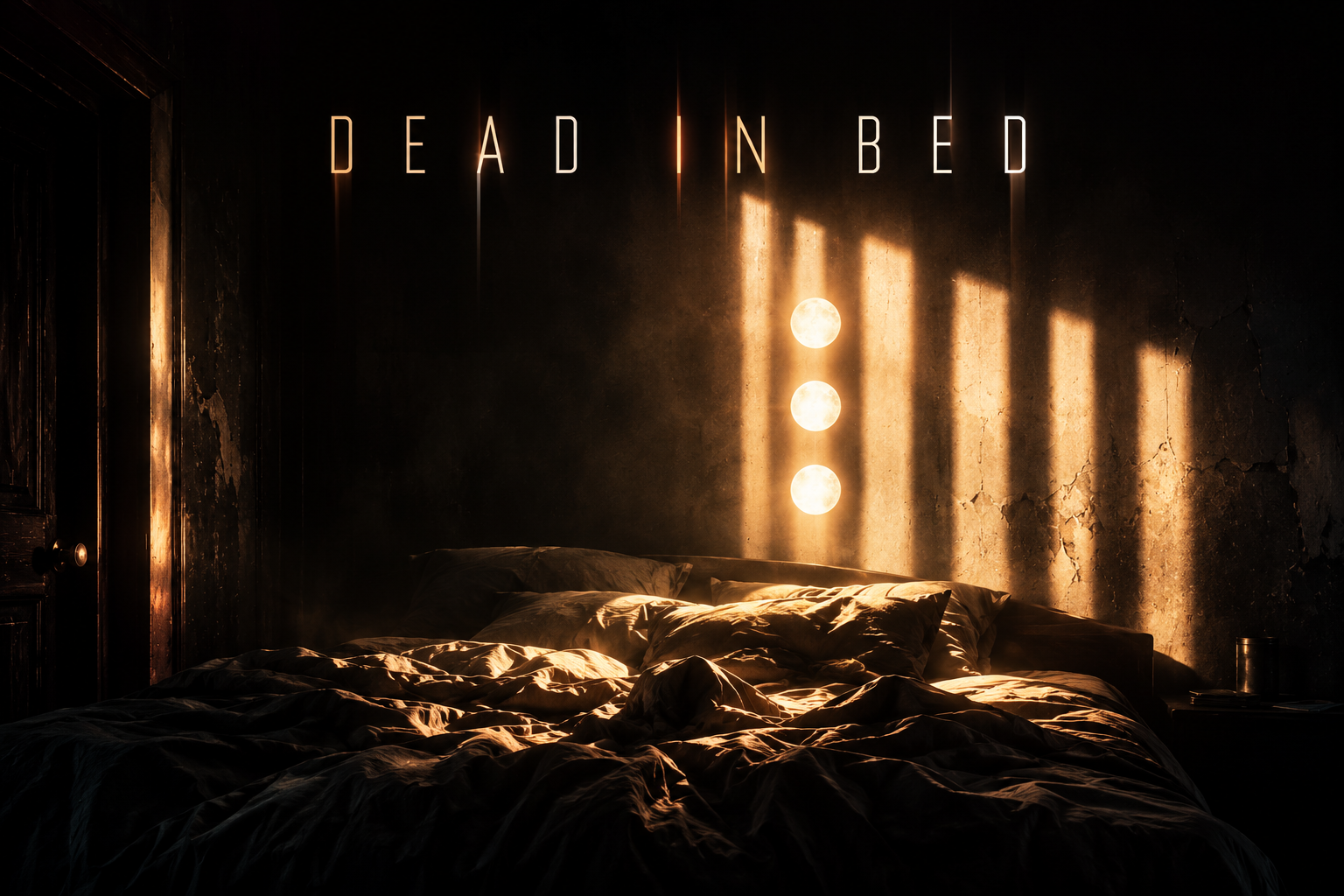
DEAD IN BED
From the Florida Keys to the Industrial Underground
The History of Dead in Bed
Dead in Bed began in the late 2000s as the solo industrial metal project of musician and songwriter Brian Sanderson. Born out of a home recording studio in the Florida Keys, the project was originally an experiment in combining crushing guitars, electronic programming, synthesizers, samples, and the mechanical aggression of industrial music.
Influenced by the darker, more experimental side of heavy music, Sanderson wrote, performed, and recorded the material himself, building songs layer by layer without the limitations of a traditional band.
What started as a one-man recording experiment would eventually become something much larger.
Influenced by the darker, more experimental side of heavy music, Sanderson wrote, performed, and recorded the material himself, building songs layer by layer without the limitations of a traditional band.
What started as a one-man recording experiment would eventually become something much larger.
From One Man to Mangrove Metal
As the music developed, Dead in Bed evolved into a full live band based in Key West, Florida. With vocalist Nigel McAteer bringing a ferocious vocal presence, the project began taking on an entirely different character.
The band's sound grew heavier, incorporating elements of thrash metal, groove metal, sludge, and industrial electronics. The result was an aggressive, unconventional style that reflected both the musicians' diverse influences and the strange environment from which the band emerged.
They called it Mangrove Metal.
Operating out of the Florida Keys, far removed from the traditional centers of the underground metal scene, Dead in Bed developed a reputation for punishing riffs, raw energy, unconventional arrangements, and intense live performances.
The band traveled throughout South Florida, performing approximately 50 shows at venues including Churchill's Pub in Miami, Tobacco Road, The Monterey Club in Fort Lauderdale, and the Hard Rock Cafe in Key West.
Mortuus Lectus — 2012
In 2012, Dead in Bed released its debut full-length album, Mortuus Lectus.
Recorded in the band's rehearsal and recording space on Rockland Key, the album captured the sound Dead in Bed had developed through years of songwriting, experimentation, and live performances.
Combining powerful live instrumentation with industrial samples, keyboards, atmospheric textures, and abrasive vocals, Mortuus Lectus documented the band's transition from its electronic beginnings into a distinctly heavier and more organic form of metal.
Songs such as "Dark Promises," "Cleansing," "Never Again," and "K66E" demonstrated the band's willingness to explore different moods and musical approaches without abandoning its aggressive foundation.
The album remains a defining document of the Mangrove Metal era.
Taking Mangrove Metal Beyond the Stage
Dead in Bed's involvement in the South Florida metal community extended beyond live performances.
The band helped establish The Mangrove Metal Show, a weekly heavy-metal radio program broadcast on Island 107.1 FM in the Florida Keys.
The show introduced listeners to underground metal, supported regional musicians, promoted live performances, and brought heavier music to an area better known for tropical rock and laid-back island entertainment.
For a time, Dead in Bed was more than just a band. It had become part of a small but determined movement to bring original heavy music to the Florida Keys.
Last Ride — The End of an Era
As the original band's time together approached its conclusion, Dead in Bed returned to the studio to capture one final collection of songs.
The result was Last Ride, a five-song EP that preserved the raw, uncompromising energy of the band's final period.
Following a farewell performance in Key West, the original live incarnation of Dead in Bed came to an end.
The recordings remained, but the project fell silent.
For more than a decade, Dead in Bed existed primarily through its albums, live recordings, and the memories of those who experienced the Mangrove Metal years.
The Return — 2026
In 2026, Brian Sanderson began rebuilding Dead in Bed, returning to the creative approach that originally gave birth to the project.
Rather than attempting to recreate the Mangrove Metal era, the new direction reconnects with Dead in Bed's industrial roots while embracing darker atmospheres, experimental electronics, heavy guitars, and unconventional sound design.
The revived project brings Sanderson back to guitar, bass, synthesizers, electronic programming, songwriting, and production, with Nigel McAteer returning on vocals.
The new incarnation aims to push Dead in Bed into unfamiliar territory, where industrial machinery collides with organic instrumentation and unsettling sonic environments.
The goal isn't nostalgia.
It's evolution.
A New Chapter
Dead in Bed has never belonged comfortably to a single genre.
From its beginnings as a solitary industrial experiment to its transformation into a South Florida metal band, the project has continuously changed shape.
Now, after years of silence, Dead in Bed is returning to where it began—with experimentation, distortion, electronic soundscapes, and a willingness to explore the uncomfortable spaces between heavy music and the unknown.
The past was Mangrove Metal.
The future is something darker.